Cava Brut Reserva
White peach and stone fruit over white flowers, then honey and a real depth of brioche and pastry. Fine, persistent bead; the acidity is completely folded in. Long, clean, balanced finish.
“Some go looking for pearls on the seabed. We would rather make them.”
Six wines from Spain’s great appellations, finished on the seabed off Alicante — in constant darkness, under pressure, in water that never leaves 15–19°C. The only submarine wine collection in the world built on a published research programme. All in the shop in Moraira now.
Wine has always been aged in the quietest, coolest, darkest place available. For most of Spain that means a cellar dug into a hillside. Bodega Submarina del Mediterráneo went the other way — down, into the sea off Cabo de las Huertas, where the water does the work a cellar has to fake.
Every wine is finished properly before it ever sees the sea — 18 months in new French oak for the Ribera, 28 months on lees for the Cava. The sea is the last chapter, not a shortcut.
Bottles are sealed with coloured wax — gold, red, blue — and loaded into patented maturation silos, then lowered to 24 metres at a point where the currents renew the water continuously.
Four things act on the wine at once and none of them are switched on by anybody: a steady 15–19°C, the pressure of 24 metres of water, total darkness, and the perpetual gentle rocking of the current.
Every batch is analysed with the Universidad de Alicante, who standardised the method. The same research tracks what the silos do to the seabed — they behave as artificial reefs, and posidonia meadows have regenerated around them.
This is the honest version, and it’s more interesting than the myth. Seawater never touches the wine. What changes is the environment the wine evolves in — and the producer’s own analyses show those wines developing differently from identical bottles left in the cellar.
In practice: the reds arrive rounder and more resolved than their age suggests, the tannin already settled. The sparkling wines pick up a finer, creamier bead and a saline lift on the finish. Nothing tastes of the sea. Everything tastes further along than it should.
“The first collection of submarine wines backed by a genuine oenological research project.”
Bodega Submarina del Mediterráneo · with the Universidad de Alicante
Each wine is bottled under a coloured wax seal — the lacre — so you can tell them apart at a glance across a table. Every one of them is in the shop in Moraira now.

White peach and stone fruit over white flowers, then honey and a real depth of brioche and pastry. Fine, persistent bead; the acidity is completely folded in. Long, clean, balanced finish.

Deep salmon, with the creamiest bead of the six. Talc, hay and dried mushroom minerality first, then apricot; swirl it and the pastry and butter arrive. Dry, high acid, a caramel-bitter twist on a very long finish.

Fruit-forward on the attack, then the French oak takes over — smoke, dried spice, leather, roasted coffee, cocoa. Black fruit underneath. Powerful, full-bodied and unusually round for its age.

The most aromatic of the reds. Dark stewed fruit, liquorice, tobacco and spice, with vanilla and roasted coffee the producer says only surfaced after the wine came back up. Structured but still fresh.

White flowers and orchard fruit with a very marked lees character. The palate is the surprise: volume and an almost oily texture, acidity woven right through it. An Atlantic wine that spent a year in the Mediterranean.
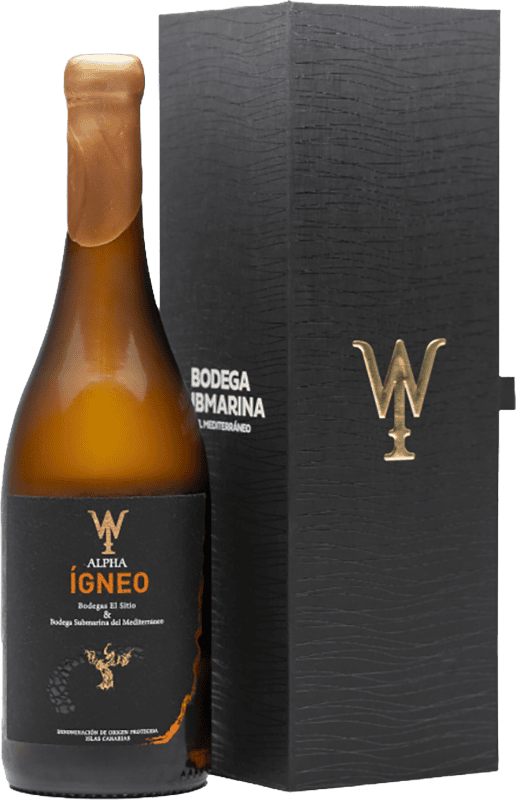
“Born in a volcanic vineyard and matured beneath the Mediterranean, Alpha Ígneo is where fire meets depth.” Volcanic soil gives Malvasía a smoke-and-ash tension that almost nothing else in Spain has; nine hundred and sixty bottles then went to the seabed. Whatever came back is not going to be repeated — and when it’s gone, that is the end of it.
Everyone arrives with a good Rioja. Almost nobody arrives with a wine that spent a year on the seabed. These sell out here every Christmas for exactly that reason — they are the rare thing that is genuinely difficult to buy and genuinely easy to explain.
W02 Rioja at €110. Familiar enough that anyone will drink it happily, strange enough that it takes over the table for ten minutes. Our pick if you want the story to land without a lecture.
CV01 Cava for the opening of the presents and W01 Ribera for the meal. Two wax seals, one gold, one gold — it looks like a set because it is one.
Alpha Ígneo 2021. Numbered, volcanic, submarine, and finite. There is a version of this Christmas where you keep it.
No. The bottles are sealed with wax and the wine never makes contact with seawater. What the sea provides is an environment — steady temperature, constant pressure, total darkness and continuous gentle movement — that the wine matures inside. Any saline impression you find on the finish is coming from the wine, not from the Mediterranean.
It would be, if it were just a bottle dunked in the sea for a photograph. This one isn’t. The method came out of a seven-year R&D programme run with the Universidad de Alicante, who standardised it and who continue to analyse each batch. It is the only submarine wine collection we know of that is backed by published oenological research rather than by marketing alone.
Because the base wines are already serious — 18 months in new French oak, 28 months on lees — and then somebody has to take a boat out, lower them 24 metres, keep them there for the best part of a year under permit, bring them back, and lose some along the way. The price reflects a second ageing that costs more than the first one.
At Cabo de las Huertas, roughly a mile and a half off the bay of Alicante, at a point where converging currents renew the water continuously. It’s about an hour and a quarter up the coast from the shop — which is, we think, the shortest journey any wine on our shelves has made.
The producer’s research with the Universidad de Alicante found the maturation silos function as artificial reefs: marine biomass around them increased, and posidonia oceanica meadows — the seagrass the western Mediterranean depends on — regenerated in the surrounding seabed.
Come and ask. We open these at tastings through the autumn, and the producer visits Moraira every year to pour them himself. If you’re considering one as a gift, that’s the visit to catch.
The photographs don’t do the wax seals justice. The whole collection is on the shelf in the shop, and we’re happy to talk you through all six — or to put one aside before December takes them.